Questions to Ask a Marietta Roofing Contractor Before You Hire
Hiring someone to work on your roof is one of those decisions that feels simple until it suddenly does not. A stain spreads across the ceiling, a shingle turns up after a storm, or water starts showing up around a chimney flashing detail, and now you need answers fast. That is exactly when people are most likely to get rushed into the wrong decision.
If you are looking for a roofing contractor in Marietta, the smartest move is not to start with price. Start with questions. Good questions tell you roof leak patch repair whether the company understands Georgia requirements, whether it knows how to approach roof repair and roof leak repair correctly, and whether it will protect your home instead of creating a bigger problem.
The right conversation should leave you feeling calmer, not more confused. A reliable contractor can explain what they are seeing, what they can document, whether permits are needed, and how they plan to handle the work. If they dodge basic questions, that is useful information too.
Start with licensing, because everything else rests on it
Before you get into shingles, flashing, leak locations, or schedules, ask a direct question: are you properly licensed in Georgia for the work you perform?
That is not paperwork for paperwork’s sake. In Georgia, residential and commercial general contractor services performed for compensation require state licensure. The state has different categories, including residential-basic, residential-light commercial, and general contracting. That matters because roof work can overlap with broader construction issues, especially if storm damage affects more than the roof covering itself.
A solid contractor should be able to explain, plainly, what license category applies to their work. They should not act annoyed that you asked. In fact, most reputable contractors appreciate homeowners who check these things, because it separates a serious project from a risky one.
It also helps to ask who, specifically, holds the license. Is it the company owner, a qualifying agent, or someone else tied to the business? You are not trying to play detective. You are making sure the company actually operates within Georgia rules instead of borrowing credibility from a name on a truck.
There is another practical reason to ask. Georgia’s contractor rules involve experience, age, competency, and examination requirements. For commercial general contractor licensing, the knowledge base includes building codes, estimating, insurance, surety bonding, and liens. You do not need your roofer to give you a lecture on all of that, but you do want a contractor whose background reflects that level of accountability.
Ask about insurance early, not after you get a quote
The next question is just as important: do you carry the insurance required to maintain your licensing?
In Georgia, insurance is a condition of applying for and maintaining contractor licensure. That is not a small detail. If a contractor gets vague when you ask about insurance, or says something like “don’t worry, we’ve been doing this forever,” that should make you pause.
A roof is a high-risk work area. Materials move up and down ladders. Workers are on slopes. Unexpected things happen around skylights, chimneys, and roof edges. You want to know the company treats insurance as part of doing business, not as an afterthought.
A straightforward contractor should be able to tell you what coverage they maintain and how they handle proof of coverage. The tone matters almost as much as the answer. Professionals are usually matter-of-fact here. Evasive people tend to overtalk.
Do you handle permits, and how do you decide when one is needed?
This question saves a lot of trouble later.
Marietta requires building permits for new construction, temporary buildings, and certain alterations to existing construction. Marietta and Cobb County also enforce current Georgia building codes. That means permit questions are not optional whenever the scope crosses into work that requires official review.
A homeowner should not have to guess whether a permit applies. Ask the contractor how they evaluate permit requirements for your specific project and who will pull the permit if one is necessary. If the answer is “we never need permits,” be careful. That kind of blanket statement is exactly the sort of thing that sounds reassuring in the moment and expensive later.
A better answer sounds more specific. Something along the lines of, “We look at the scope, determine whether the work qualifies as an alteration requiring a permit, and handle compliance if it does.” That shows they understand both the local process and the difference between a simple repair and larger roof work.
This becomes especially important if the problem extends beyond surface materials. A roof leak repair can be simple in one case and much more involved in another. The contractor should be able to explain where your project falls without guessing.
How will you inspect the roof, and what exactly are you looking for?
A good roof inspection is not just a walk-around followed by a price. Ask how they inspect for damage and what they expect to document.
This is where experience shows up fast. Roof problems do not always announce themselves in obvious ways. Hail can damage roof coverings and shorten roof life. Wind and other hazards can create conditions that lead to water intrusion. A leak may show inside a bedroom ceiling, but the real entry point can be somewhere else entirely.
That is why you want to hear a contractor talk about more than just the visible symptom. Ask whether they inspect likely water-entry details such as flashing and valleys. Those are critical areas. Flashing and valley flashing are key water-shedding details, and if they are poorly installed or loosened, they can allow water infiltration. Valleys, in particular, are common leak points because they concentrate runoff.
If I were hiring for my own house, I would listen carefully for whether the contractor speaks in cause-and-effect language. Not “there’s a stain, so you need a whole new roof.” Instead, “the stain tells us water is entering somewhere, and we need to trace whether it is coming through flashing, a valley, or another point where the roof system sheds water.”
That is a very different mindset. One is sales. The other is diagnosis.
How do you approach roof leak repair when the source is not obvious?
This is one of the most useful questions you can ask, especially if your main issue is active leaking.
A seasoned roofing contractor knows that leak tracing requires patience. Water rarely enters and appears in the same place. It can travel along decking, framing, or interior surfaces before it finally shows itself indoors. That is why the best roof leak repair work starts with understanding the path of water, not just patching the nearest spot.
Ask the contractor how they confirm the source of a leak before recommending a fix. You are looking for thoughtful process, not magic certainty. If someone claims they can identify every hidden leak in two minutes from the driveway, that is hard to take seriously.
You also want to hear that they understand how roof components work together. FEMA guidance notes that flashing must be integrated with shingles and underlayment to prevent water entry. That single point says a lot. Leak repair is not just about replacing one visible part. It is about restoring the system so water sheds correctly again.
This is where cheap repairs often fail. A quick patch may stop drips for a week, then the next storm proves the actual issue was never resolved. Asking how they diagnose the leak forces the contractor to reveal whether they are solving problems or just buying time.
If my roof has storm damage, how do you document it?
Storm damage projects create a different kind of stress. People want quick help, but that urgency can attract rushed decisions and bad actors.
Georgia’s insurance regulator advises homeowners after severe weather to photograph damage, notify the insurer immediately, tarp a damaged roof if safe, and avoid signing with rushed or unsolicited contractors. That guidance gives you a strong framework for your conversation.
Ask the contractor how they document storm damage and what they recommend you do before work starts. A careful company should encourage clear photos, prompt insurer notification, and temporary protection if it is safe to install. They should not pressure you into signing something at the door just because a storm rolled through.
This is also a good time to ask how they distinguish between emergency stabilization and permanent repair. Those are not the same thing. Tarping a damaged area can help limit interior water damage, but it is not the same as a full roof repair plan. A contractor who communicates that difference clearly is usually easier to work with from start to finish.
If your home suffered serious damage, there may be questions about disaster assistance as well. FEMA notes that ceiling and roof damage from disaster-caused leaks may be eligible for assistance, with verification typically done by on-site inspection. A responsible contractor should understand the value of documentation and inspection, even if they are not the agency making those decisions.
Will you explain whether I need repair work or something larger?
This is where homeowners often feel stuck. They know something is wrong, but they do not know whether they need a localized repair, broader corrective work, or simply better diagnosis.
Ask the contractor to explain why they recommend a certain scope. Not just what they want to do, but why. If roof leak repair they suggest roof repair in one area, what evidence supports keeping the rest intact? If they suggest a larger project, what conditions led them there?
You do not need them to oversell certainty. In fact, honest uncertainty can be a good sign. A trustworthy roofer might say, “Based on what we can see, the failure appears concentrated around the valley and adjacent flashing, but we will know more once we remove the affected materials.” That kind of answer reflects real field conditions.
I have always found that the best contractors talk in terms of observable conditions, likely causes, and reasonable next steps. The worst ones jump straight from symptom to invoice.
What building code and compliance issues should I know about?
This question sounds dry, but it often separates organized professionals from companies that simply install and move on.
Because Marietta and Cobb County enforce current Georgia building codes, your contractor should be able to speak to compliance without making it sound mysterious. You are not asking them to quote code sections from memory. You are asking whether they work with the understanding that roof work needs to meet current code requirements where applicable.
This matters even more on commercial projects or mixed-use properties, where licensing categories and compliance responsibilities become more complex. Georgia also has a commercial general contractor limited tier option tied to a financial cap. That may not apply to many homeowners, but it is another reminder that licensing and scope are connected. A serious contractor should know where their authority and project limits begin and end.
Who is actually doing the work?
A lot of frustration starts when the person who gave the estimate disappears and a different crew shows up with different assumptions.
Ask who will perform the work, who supervises the site, and who your point of contact will be if there is a change or a concern. You are not looking for a scripted answer. You are trying to find out whether the company runs a controlled process or a loose one.
On roof projects, details matter. Flashing integration matters. Valley details matter. Temporary weather protection matters. Communication matters. If the handoff between estimator and crew is sloppy, small details can get missed, and small details are exactly what keep water out.
How will you protect the house if weather interrupts the job?
This is one of those practical questions homeowners often forget to ask until the sky darkens halfway through the project.
Because severe weather can hit with little warning, the contractor should be able to explain what they do if part of the roof is opened and conditions change. Georgia’s insurance regulator specifically advises homeowners to tarp a damaged roof if safe after severe weather. That does not mean every homeowner should climb up and do it themselves. It means temporary protection matters, and any roofer worth hiring should take it seriously.
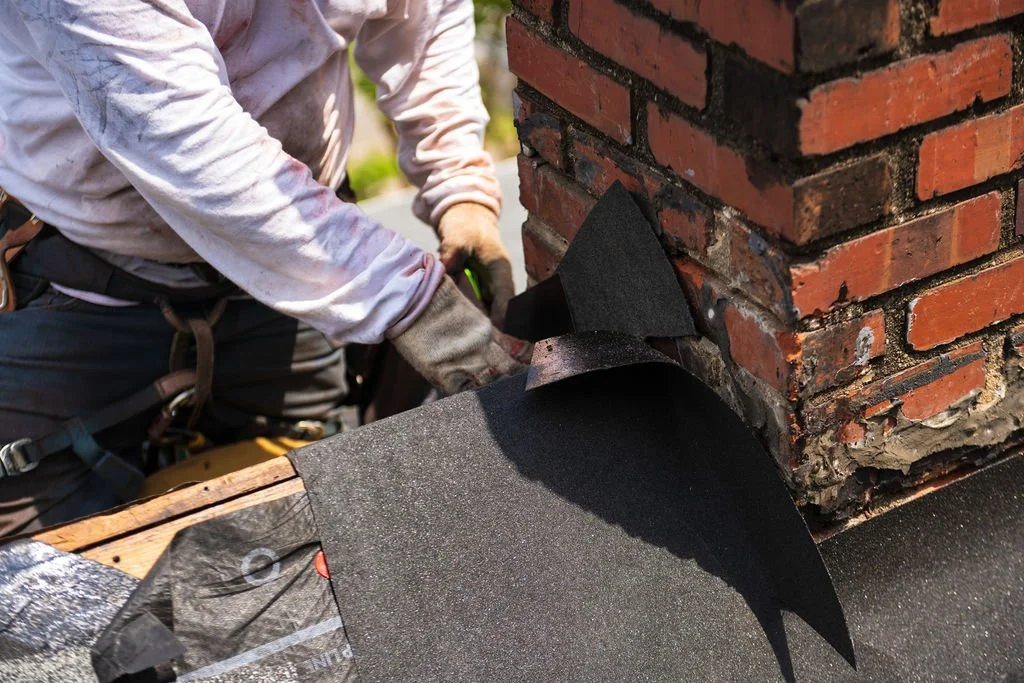
Listen for an answer that sounds like jobsite planning, not wishful thinking. Roofs are exposed systems. Once materials are removed, the contractor needs a plan to keep water from entering if work pauses.
A few questions worth keeping on one page
If you want a simple note to bring into a meeting or phone call, these are the questions I would prioritize:
- Are you properly licensed in Georgia for this type of work, and who holds the license?
- Do you carry the insurance required to maintain your licensing?
- Will this project require a permit in Marietta, and if so, will you handle it?
- How will you inspect and document the cause of the problem, especially if this is a roof leak repair?
- If storm damage is involved, how should I document the damage and coordinate next steps?
That short list will tell you more than a polished sales pitch ever will.
Red flags that deserve your attention
Sometimes the warning signs are not subtle. If you hear any of the following, slow down:
- “You do not need to worry about licensing, we’ve always done it this way.”
- “Permits just slow things down, so we skip them.”
- “Sign now before someone else takes your spot,” especially right after a storm.
- “We can tell you exactly what is wrong without inspecting flashing, valleys, or leak paths.”
- “Don’t bother taking photos or contacting your insurer yet.”
A trustworthy contractor does not need to rush you past basic due diligence.
The best answers are usually calm, specific, and a little boring
That may sound strange, but it is true. Good contractors rarely rely on drama. They do not need sweeping claims. They explain scope, licensing, insurance, permit handling, inspection methods, and repair logic in a way that makes sense.
When someone knows roof systems, you can hear it in the details. They understand that a leak around a ceiling stain may involve a valley higher up the slope. They understand that flashing is not trim, it is a water-management component. They understand that hail, wind, and storm exposure can damage roof coverings and shorten service life. They understand that local permit rules and Georgia licensing rules are part of the job, not extra paperwork the homeowner has to sort out alone.
That is the sort of roofing contractor you want in Marietta. Not the fastest talker. Not the lowest number scribbled on a card. The one who can answer sensible questions without getting defensive, make a clear plan for roof repair or roof leak repair, and handle the project in a way that respects both your home and Georgia requirements.
If you remember nothing else, remember this: the quality of the answers usually predicts the quality of the job. A roof keeps water out only when the details are handled correctly. Hiring the right person starts the same way. Ask better questions, and weak contractors tend to eliminate themselves.